
The Ardmor Hub
One live system, and the evidence attached as you go.
Every register, permit, inspection and incident in one place, with the dates, photos and signatures already on them. Built for the Victorian OHS Act 2004, and priced per site so your whole crew can be on it.
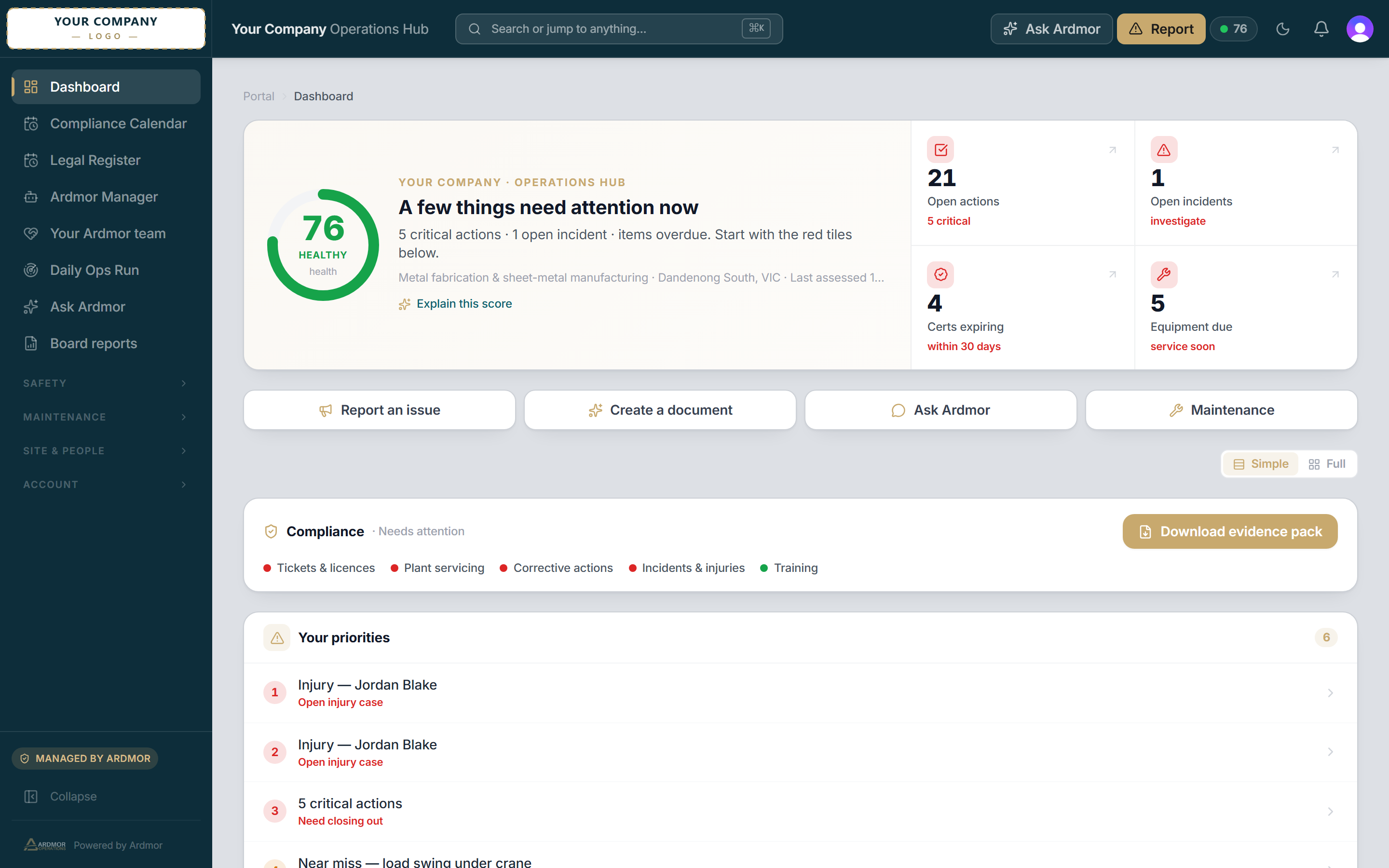
Start by recording what happens. Add the proof when you need it.
The free plan is not a trial with a clock on it. Recording is genuinely free, because a hazard nobody wrote down is the expensive one. What we charge for is the work on top: drafting the fix, writing the procedure, and running the maintenance system.
Free
$0Record it, and keep the record.
Reporting, routine checks, toolbox talks, first aid, printable permit books in your own name, and your whole crew.
Safety
$249Prove you controlled it.
Every register and document an inspector asks for, joined to the job it came from, with the fixes drafted for you.
Operations
$399And keep the plant running.
Everything in Safety plus the full maintenance system, reliability reporting, and a daily run that works the list for you.
Per site, per month, unlimited workers. The full comparison is on the pricing page.
What it actually does
Grouped by the job rather than by the menu. The plan beside each block is the one that unlocks it.
Get it reported before it gets forgotten
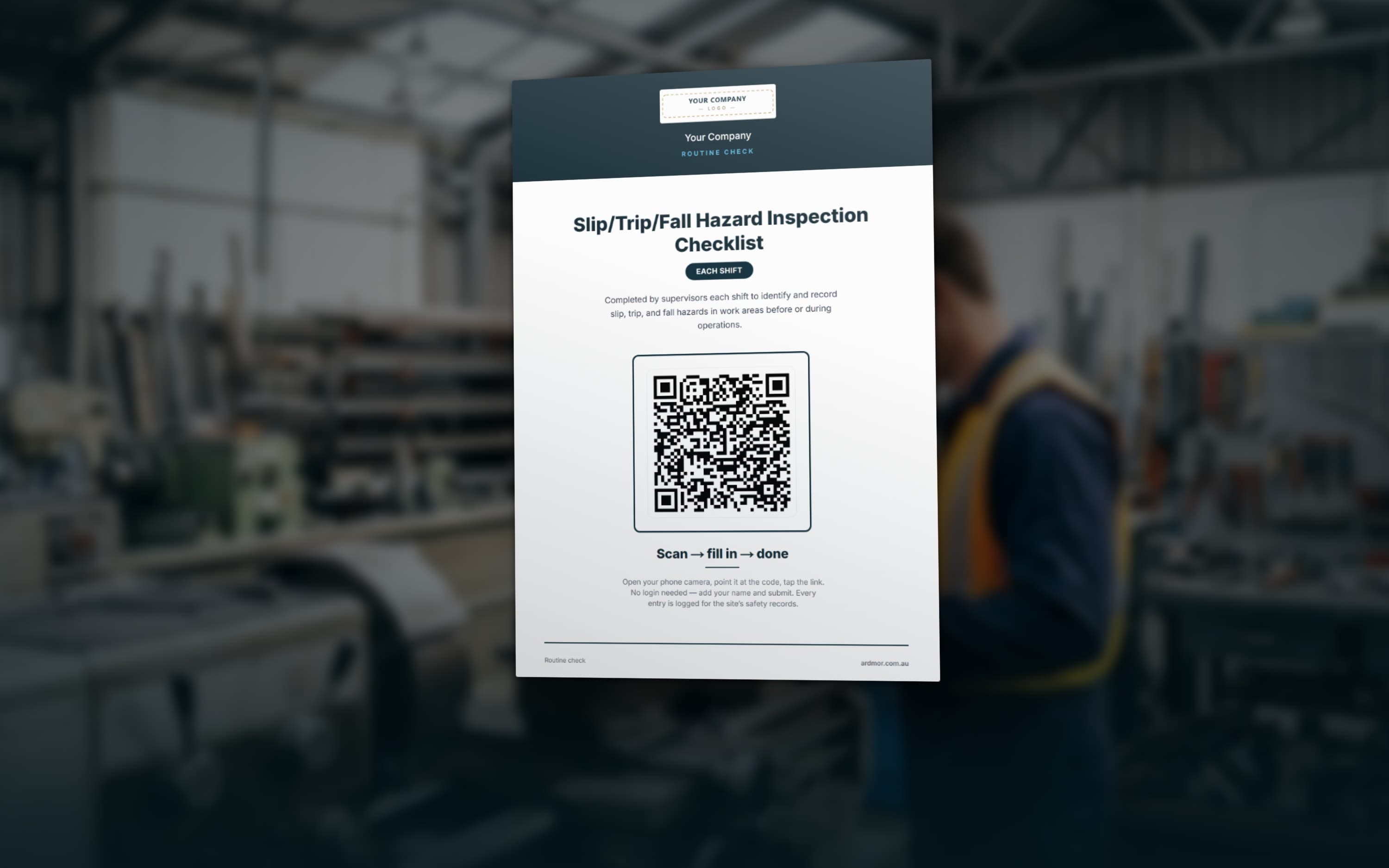
A hazard is only useful if it reaches somebody. A QR poster on the wall takes a report with no login and no app to install, so a contractor or a new starter can raise something in the time it takes to scan it.
- Hazard and incident reporting from the poster, the phone or the desk
- Routine check forms, filled in from a QR sticker and kept as history
- Toolbox talks and pre-starts with attendance sign-on — consultation is a duty, so the record of it is never paywalled
- Stop and Think pre-task checks on the worker's phone
- First-aid guidance, step by step, on every plan including this one
Prove you controlled it, not just that you knew
The registers and the paper an inspector asks for, joined to the job they came from. A permit knows which JSEA it references, and the JSEA knows which permits it supports.
- Risk register with before-and-after scoring
- JSEAs, SWMS, emergency response and business continuity plans
- Permits to work — requested from the field, authorised, signed on, closed out with an evidence pack
- A live register of issued permits, so you can answer whether anyone is in that space right now
- Job Pack — describe one job, get the whole cross-referenced document set written for it
Check the place before it bites someone
Inspections against your own checklists, or a photograph instead of a checklist when nobody has time for one. A live health score turns all of it into a ranked list of what to fix first.
- Digital inspections with photo evidence, against reusable templates
- Snap an audit — take a picture, get the hazards read back
- A compliance calendar showing what is due, overdue and expiring
- Guided close-outs that draft the compliance document the fix needs
- A legal register that tracks what changed in the law and what it means for you
Know who is allowed to do what
Competency is the question after an incident, and it is a records question. Tickets and licences sit on the person, with the expiry tracked, so nothing lapses quietly.
- Training records and a competency matrix built from them
- Tickets and licences on every worker, expiry tracked
- Injury cases — first aid through return to work, on the same record as the incident
- Contractor management — inductions, insurances, public liability and WorkCover currency
- A sign-in log fed by a QR poster at the gate, and a view of who is on site right now
The plant, the substances and the site itself
Registers your crew can actually reach. A safety data sheet is worth nothing in a folder in the office when somebody is holding the drum.
- Equipment register, with a QR sticker on the machine
- Chemical and SDS register, searchable from a phone on the floor
- An interactive emergency site map — exits, extinguishers, the defibrillator, assembly points
- A gap review on that map, so you find out what is missing before a drill does
Keep the plant running
The maintenance system, in the same place as the safety system, because a machine that breaks unsafely is one event and not two.
- Work orders, preventive maintenance schedules and parts
- Reliability and cost reporting — mean time to repair, mean time between failures, uptime
- A daily run that produces the day's queue for you to approve
- Matrices computed live from your registers: skills gaps, contractor compliance, the risk heat map
- Board and executive reports — board-ready in one click
Routine checks
Stick it on the wall. They scan it with their phone.
No login, no app to install. The check is filled in where it happens, and the record lands in the Hub.
The half of it that lives on the floor
A safety system only works if the people doing the work can reach it in the thirty seconds they have. The worker app shows a person their own documents, the safety data sheet for the drum in their hand, the site map with the defibrillator on it, and the permits they are signed onto.
It shows them only what their plan and their role allow, and never an upgrade prompt. Workers do not make purchasing decisions, so putting a price in front of one is just an obstacle between a person and a hazard report.
The app needs a login, because it holds your business’s documents and people. The QR posters do not — reporting a hazard, running a routine check and signing in at the gate all work with nothing installed and nobody enrolled.
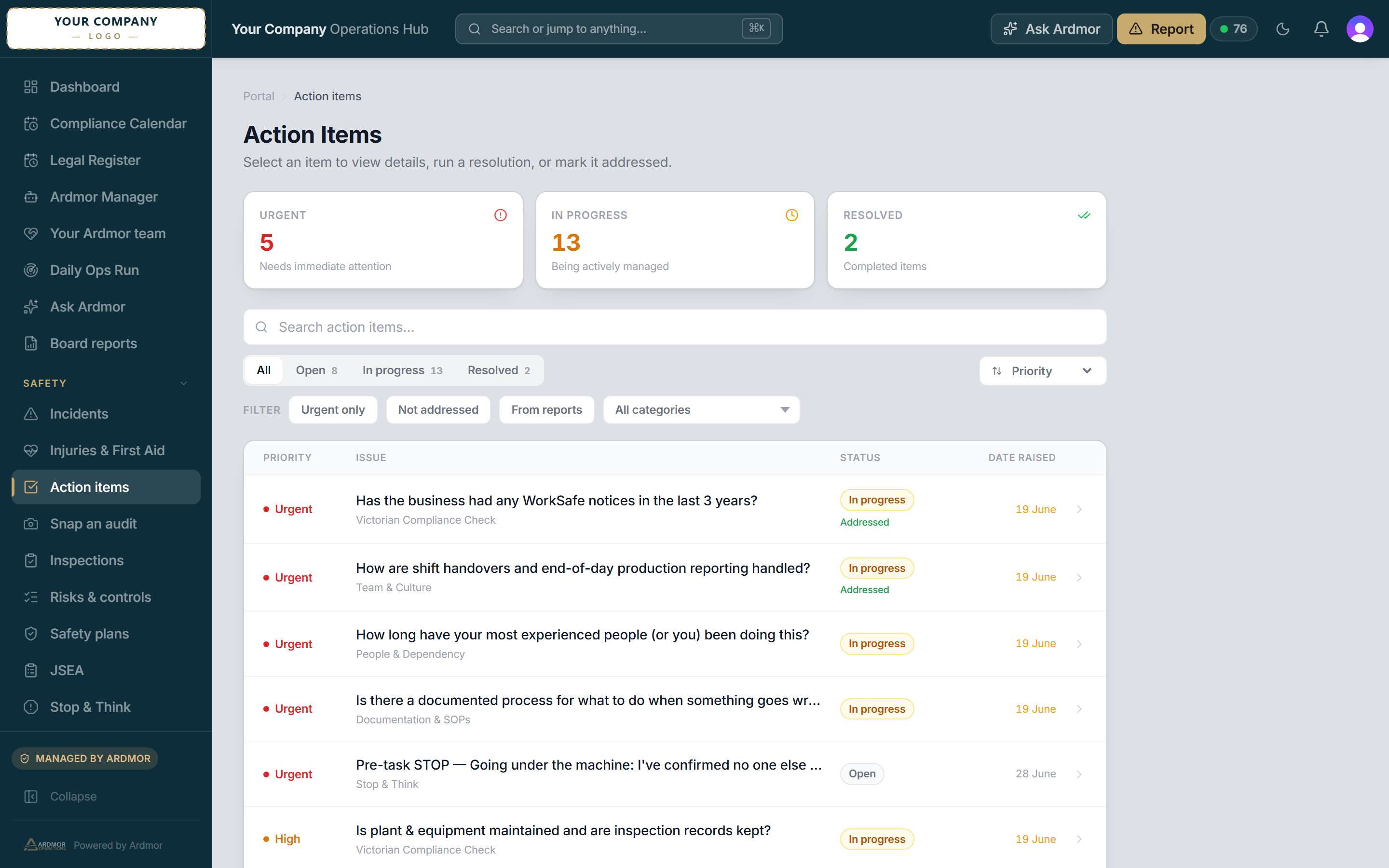
The desk view of the same work. A phone capture of the worker app is coming — we would rather show you the real screen late than a mock-up now.
Why the state matters
Written for the Act you actually work under.
Every other state and territory adopted the model Work Health and Safety laws. Victoria did not. We run on the Occupational Health and Safety Act 2004 and the OHS Regulations 2017 — a different Act, different language and a different duty holder.
So the documents this system writes cite Victorian instruments, the permit books are written to them, and when the law changes we read the change and tell you what it means for your site. A national tool cannot do that without picking a state, and it has not picked yours.
See a document it writesQuestions people actually ask
- Do our workers need to create accounts?
- Not to report something. The QR posters — hazard reporting, routine checks and the sign-in log at the gate — take a submission with no login and nothing installed, which is how a contractor or a labour-hire worker uses it on their first day. The worker app itself does need a login, because it shows your documents, your permits and your people.
- What does the free plan actually include?
- Hazard and incident reporting from the poster, the app and the desk; routine check forms with their history; toolbox talks and pre-starts with attendance; the first-aid assistant; Stop and Think checks; printable permit and JSEA books in your own business name; ten Ask Ardmor questions a month; your document library with three procedures drafted a month; a stock take; and your full employee register with unlimited workers. No card, and no trial clock.
- Is it built for Victoria specifically?
- Yes, and that is the point. Victoria never adopted the model WHS laws, so the documents cite the Occupational Health and Safety Act 2004 and the OHS Regulations 2017, and the permit books are written to them. A template that says PCBU was written for another state.
- What happens to the documents we already have?
- They come with you. Store them in the library, link them to the registers they belong to, and put them under version control with review dates so they do not quietly go stale.
- Is anything charged per person?
- No. Every plan is priced per site with unlimited workers, so putting your whole crew on it never changes the bill.